Brief considerations on ethics for artificial intelligence neurotechnologies
DOI:
https://doi.org/10.60144/v5i.2024.120Palavras-chave:
Neurotechnology, Artificial intelligence, Ethics, Governance, Brain-computer interfaceResumo
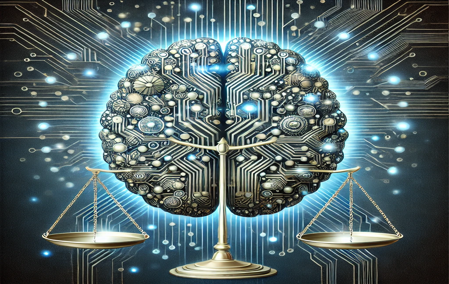
Introduction: implants and technological devices are being used to decode neural activity to move a prosthetic arm, control an avatar, and turn thoughts into text through an AI-based decoder. These situations are designed by Brain-computer Interface (BCI), one of the main AI-based neurotechnologies used to understand the brain and to improve people's welfare. In 2023, UNESCO already recognized its benefits but also revealed the potential ethical issues and problems, particularly with its use of non-invasive interventions. Objective: so, this essay aims to answer the following research question: which Ethical standards can be designed and used to balance the person’s rights with technological development to prevent vulnerability situations? Method: the methods used in this work is the bibliographic research plus the hermeneutic interpretation. Results: it proposes Ethical standards for protecting the rights of the vulnerable to ensure that these rights are respected. Conclusions: there is no need for the creation of a new neurorights. Privacy and intimacy can and will deal with all the issues of neurotechnologies. However, it is necessary to improve the protection of the owner's rights through strong ethical and governance standards.
Downloads
Referências
ADOMAITIS, Laurynas; GRINBAUM, Alexei. Neurotechnologies, ethics, and the limits of free will. Integrative Psychological and Behavioral Science, Nova York, p. 1-14, 2024. Available in: https://link.springer.com/article/10.1007/s12124-023-09782-3. Accessed in: 25 sept. 2024.
ARSTILA, Valtteri; SCOTT, Franklin. Brain reading and mental privacy. Trames: A Journal of the Humanities and Social Sciences, Tallinn, v. 15, n. 2, p. 204, 2011. Available in: https://www.kirj.ee/trames-2011-vol-15-issue-2/. Accessed in: 25 sept. 2024.
AZOULAY, Audrey. The Ethics of Neurotechnology: UNESCO appoints international expert group to prepare a new global standard. UNESCO. 2024. Available in: https://www.unesco.org/en/articles/ethics-neurotechnology-unesco-appoints-international-expert-group-prepare-new-global-standard. Accessed in: 11 sept. 2024.
BEAUCHAMP, Tom L.; CHILDRESS, James F. Principles of biomedical ethics. São Paulo: Edições Loyola, 1994.
BERGER, Sara; ROSSI, Francesca. The future of AI ethics and the role of neurotechnology. In: WORKSHOP ON ADVERSE IMPACTS AND COLLATERAL EFFECTS OF ARTIFICIAL INTELLIGENCE TECHNOLOGIES, 2021. CEUR-WS, 2021. Available in: https://research.ibm.com/publications/the-future-of-ai-ethics-and-the-role-of-neurotechnology. Accessed in: 11 sept. 2024.
BOSTROM, Nick. A history of transhumanist thought. Journal of Evolution and Technology, Hartford, v. 14, n. 1, 2005. Available at: https://jetpress.org/volume14/bostrom.pdf. Accessed on: 25 Sept. 2024.
BUBLITZ, Christoph. Moral enhancement and mental freedom. Journal of Applied Philosophy, Oxford, v. 33, n. 1, p. 88-106, 2016. Available at: https://onlinelibrary.wiley.com/doi/abs/10.1111/japp.12172. Accessed on: 25 Sept. 2024.
COENEN, Christopher. Deliberating visions: The case of human enhancement in the discourse on nanotechnology and convergence. In: Governing Future Technologies: Nanotechnology and the Rise of an Assessment Regime. Heidelberg: Springer, 2010. p. 73-87. Available at: https://link.springer.com/chapter/10.1007/978-90-481-2834-1_6. Accessed on: 25 Sept. 2024.
CORTIZ, Diogo. A narrative review of fairness and morality in neuroscience: insights to artificial intelligence. AI and Ethics, New York, v. 3, n. 3, p. 769-780, 2023. Available at: https://link.springer.com/article/10.1007/s43681-022-00147-6. Accessed on: 25 Sept. 2024.
DEVLIN, H. AI makes non-invasive mind-reading possible by turning thoughts into text. The Guardian, Londres, 2023. Available at: https://www.theguardian.com/technology/2023/may/01/ai-makes-non-invasive-mind-reading-possible-by-turning-thoughts-into-text. Accessed on: 11 Sept. 2024.
DEWEY, John; TUFTS, James Hayden. Ethics. Chicago: DigiCat, 2022.
DOYA, Kenji et al. Social impact and governance of AI and neurotechnologies. Neural Networks, Oxford, v. 152, p. 542-554, 2022.
FELZMANN, Heike et al. Transparency you can trust: Transparency requirements for artificial intelligence between legal norms and contextual concerns. Big Data & Society, Londres, v. 6, n. 1, p. 2053951719860542, 2019. Available at: https://journals.sagepub.com/doi/10.1177/2053951719860542. Accessed on: 25 Sept. 2024.
FRIEDRICH, Orsolya; WOLKENSTEIN, Andreas. Introduction: Ethical issues of neurotechnologies and artificial intelligence. In: FRIEDRICH, Orsolya; WOLKENSTEIN, Andreas. Clinical Neurotechnology Meets Artificial Intelligence: Philosophical, Ethical, Legal and Social Implications, Nova York, p. 1-9, 2021. Available at: https://link.springer.com/chapter/10.1007/978-3-030-70942-7_1. Accessed on: 25 Sept. 2024.
GALIAUTDINOV, Rinat; MKRTTCHIAN, Vardan. Brain machine interface for avatar control and estimation for educational purposes based on neural AI plugs: theoretical and methodological aspects. In: Avatar-Based Control, Estimation, Communications, and Development of Neuron Multi-Functional Technology Platforms. Hershey: IGI Global, 2020. p. 294-316. Available at: https://www.igi-global.com/chapter/brain-machine-interface-for-avatar-control/244793. Accessed on: 25 Sept. 2024.
GILBERT, Frederic; RUSSO, Ingrid. Mind-reading in AI and neurotechnology: evaluating claims, hype, and ethical implications for neurorights. AI and Ethics, New York, p. 1-18, 2024. Available at: https://link.springer.com/article/10.1007/s43681-023-00195-x. Accessed on: 25 Sept. 2024.
GOODWIN, Nastacia L. et al. Toward the explainability, transparency, and universality of machine learning for behavioral classification in neuroscience. Current Opinion in Neurobiology, Oxford, v. 73, p. 102544, 2022. Available at: https://www.sciencedirect.com/science/article/pii/S095943882200084X. Accessed on: 25 Sept. 2024.
HILDT, Elisabeth; LAAS, Kelly; SZIRON, Monika. Shaping ethical futures in brain-based and artificial intelligence research. Science and Engineering Ethics, Dordrecht, v. 26, p. 2371-2379, 2020. Available at: https://link.springer.com/article/10.1007/s11948-020-00245-4. Accessed on: 25 Sept. 2024.
IENCA, Marcello; IGNATIADIS, Karolina. Artificial intelligence in clinical neuroscience: methodological and ethical challenges. AJOB Neuroscience, Abingdon, v. 11, n. 2, p. 77-87, 2020. Available at: https://www.tandfonline.com/doi/full/10.1080/21507740.2020.1736914. Accessed on: 25 Sept. 2024.
JOTTERAND, Fabrice; BOSCO, Clara. Keeping the “human in the loop” in the age of artificial intelligence: accompanying commentary for “correcting the brain?” by Rainey and Erden. Science and Engineering Ethics, Dordrecht, v. 26, n. 5, p. 2455-2460, 2020. Available at: https://link.springer.com/article/10.1007/s11948-019-00134-w. Accessed on: 25 Sept. 2024.
JOYCE, Dan W. et al. Explainable artificial intelligence for mental health through transparency and interpretability for understandability. npj Digital Medicine, Londres, v. 6, n. 1, p. 6, 2023. Available at: https://www.nature.com/articles/s41746-022-00735-3. Accessed on: 25 Sept. 2024.
KESKINBORA, Kadircan H. Medical ethics considerations on artificial intelligence. Journal of Clinical Neuroscience, Oxford, v. 64, p. 277-282, 2019. Available at: https://www.sciencedirect.com/science/article/abs/pii/S0967586819303210. Accessed on: 25 Sept. 2024.
LIAO, S. Matthew. A short introduction to the ethics of artificial intelligence. In: LIAO, S. Matthew (Ed.). Ethics of Artificial Intelligence. Oxford: Oxford University Press, 2020, p. 1-45. Available at: https://global.oup.com/academic/product/ethics-of-artificial-intelligence-9780190905033. Accessed on: 25 Sept. 2024.
METIN, Sinem Zeynep et al. Deep learning-based artificial intelligence can differentiate treatment-resistant and responsive depression cases with high accuracy. Clinical EEG and Neuroscience, Nova York, p. 15500594241273181, 2024. Available at: https://journals.sagepub.com/doi/abs/10.1177/15500594241273181. Accessed on: 25 Sept. 2024.
MIŚKIEWICZ, Julia. The merger of natural intelligence with artificial intelligence, with a focus on Neuralink company. Virtual Economics, Warsaw, v. 2, n. 3, p. 22-29, 2019. Available at: https://virtual-economics.eu/index.php/VE/article/view/24. Accessed on: 25 Sept. 2024.
MÜLLER, Oliver; ROTTER, Stefan. Neurotechnology: current developments and ethical issues. Frontiers in Systems Neuroscience, Lausanne, v. 11, p. 93, 2017. Available at: https://www.frontiersin.org/articles/10.3389/fnsys.2017.00093/full. Accessed on: 25 Sept. 2024.
RAINEY, Stephen; ERDEN, Yasemin J. Correcting the brain? The convergence of neuroscience, neurotechnology, psychiatry, and artificial intelligence. Science and Engineering Ethics, Dordrecht, v. 26, n. 5, p. 2439-2454, 2020. Available at: https://link.springer.com/article/10.1007/s11948-020-00254-3. Accessed on: 25 Sept. 2024.
REUTERS. Neuralink's first human patient able to control mouse through thinking, Musk says. Reuters, Londres, 2024. Available at: https://www.reuters.com/business/healthcare-pharmaceuticals/neuralinks-first-human-patient-able-control-mouse-through-thinking-musk-says-2024-02-20/. Accessed on: 11 Sept. 2024.
RODOTÀ, Stefano. Data protection as a fundamental right. In: Reinventing Data Protection? Dordrecht: Springer Netherlands, 2009. p. 77-82. Available at: https://link.springer.com/chapter/10.1007/978-1-4020-9498-9_5. Accessed on: 25 Sept. 2024.
RODOTÀ, Stefano. Persona, libertà, tecnologia - Note per una discussione. Diritto & Questioni Pubbliche, Palermo, v. 5, p. 25, 2005. Available at: http://www.dirittoequestionipubbliche.org/page/2005_n5.php. Accessed on: 25 Sept. 2024.
RODOTÀ, Stefano. Tra diritti fondamentali ed elasticità della normativa: il nuovo codice sulla privacy. Europa e Diritto Privato, Milão, v. 1, p. 1-11, 2004. Available at: https://www.iusexplorer.it/Riviste/DettaglioRivista?idRivista=119. Accessed on: 25 Sept. 2024.
RUS, Meta; GROSELJ, Urh. Ethics of vaccination in childhood—A framework based on the four principles of biomedical ethics. Vaccines, Basel, v. 9, n. 2, p. 113, 2021. Available at: https://www.mdpi.com/2076-393X/9/2/113. Accessed on: 25 Sept. 2024.
RUSSELL, S.; NORVIG, P. Artificial Intelligence: a modern approach. New Jersey: Pearson Education, 2010.
SANI, Omid G.; PESARAN, Bijan; SHANECHI, Maryam M. Dissociative and prioritized modeling of behaviorally relevant neural dynamics using recurrent neural networks. Nature Neuroscience, Londres, p. 1-13, 2024. Available at: https://www.nature.com/articles/s41593-023-01294-8. Accessed on: 25 Sept. 2024.
SAVULESCU, Julian; SANDBERG, Anders; KAHANE, Guy. Well‐being and enhancement. In: SAVULESCU, J.; MEULEN, R.; KAHANE, G. (Eds.). Enhancing Human Capacities. West Sussex: Blackwell Publishing, 2011, p. 1-18. Available at: https://onlinelibrary.wiley.com/doi/book/10.1002/9781444393545. Accessed on: 25 Sept. 2024.
SHEN, Francis X. Neuroscience, mental privacy, and the law. Harvard Journal of Law & Public Policy, Cambridge, v. 36, p. 653, 2013. Available at: https://harvard-jlpp.com/vols-36-40/. Accessed on: 25 Sept. 2024.
SOLUM, Lawrence B. Legal personhood for artificial intelligences. In: SOLUM, Lawrence B. Machine Ethics and Robot Ethics. Abingdon: Routledge, 2020, p. 415-471. Available at: https://www.routledge.com/Machine-Ethics-and-Robot-Ethics/Anderson-Anderson/p/book/9781138585101. Accessed on: 25 Sept. 2024.
TAM, Wing-kin et al. Human motor decoding from neural signals: a review. BMC Biomedical Engineering, Londres, v. 1, p. 1-22, 2019. Available at: https://bmcbiomedeng.biomedcentral.com/articles/10.1186/s42490-019-0005-5. Accessed on: 25 Sept. 2024.
YUSTE, Rafael et al. Four ethical priorities for neurotechnologies and AI. Nature, Londres, v. 551, n. 7679, p. 159-163, 2017. Available at: https://www.nature.com/articles/551159a. Accessed on: 25 Sept. 2024.
WALLACH, Wendell. From robots to techno sapiens: ethics, law and public policy in the development of robotics and neurotechnologies. Law, Innovation and Technology, Abingdon, v. 3, n. 2, p. 185-207, 2011. Available at: https://www.tandfonline.com/doi/abs/10.5235/17579961.3.2.185. Accessed on: 25 Sept. 2024.
Downloads
Publicado
Como Citar
Licença
Copyright (c) 2024 Sthéfano Divino

Este trabalho está licenciado sob uma licença Creative Commons Attribution 4.0 International License.
Qualquer usuário tem direito de:
- Compartilhar — copiar, baixar, imprimir ou redistribuir o material em qualquer suporte ou formato
- Adaptar — remixar, transformar, e criar a partir do material para qualquer fim, mesmo que comercial.
De acordo com os seguintes termos:
- Atribuição — Você deve dar o crédito apropriado, prover um link para a licença e indicar se mudanças foram feitas. Você deve fazê-lo em qualquer circunstância razoável, mas de maneira alguma que sugira ao licenciante a apoiar você ou o seu uso.
- Sem restrições adicionais — Você não pode aplicar termos jurídicos ou medidas de caráter tecnológico que restrinjam legalmente outros de fazerem algo que a licença permita.